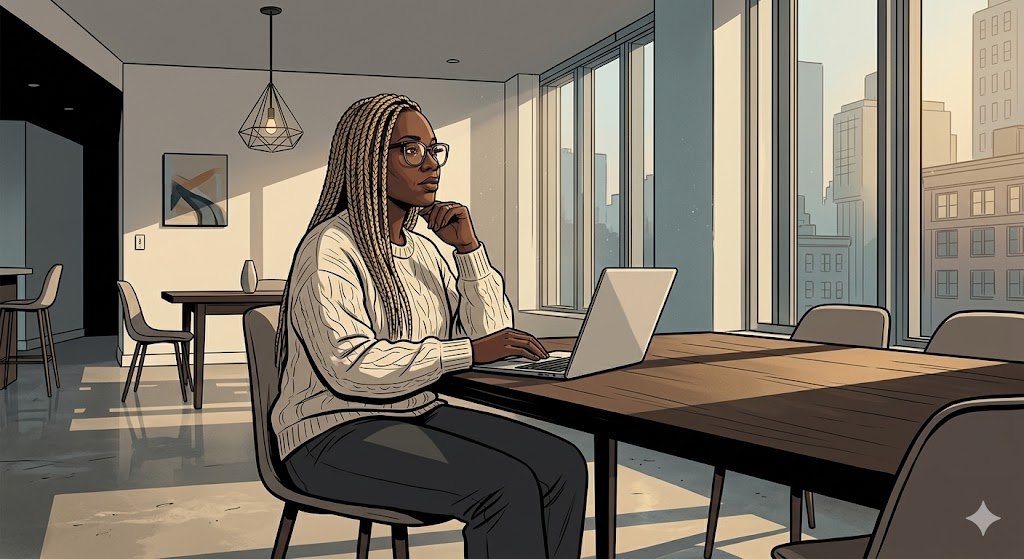
We love a woman who handles it.
You know her. She's the one who figured out the moving logistics and still made it to the dinner with a full face and a contribution to the conversation. She's the one who sends the follow-up email before you even thought to ask for it. She's the one who shows up for everyone, professionally and personally, without visible effort. We describe her like she's a wonder of engineering. She has it together. She handles her business. She never seems to need anything.
We love her because she makes everyone around her feel safe and capable. We love her because she never asks anything inconvenient of us. We love her because she performs self-sufficiency with a fluency that feels like a superpower.
And somewhere along the way, a lot of us became her.
I've been thinking about what it actually takes to need nothing. Not to genuinely require nothing, but to perform that state so consistently and so well that asking for help starts to feel like a failure of character. There's a version of self-sufficiency that is actual strength, actual confidence, actual I've-built-something-here competence. And then there's the version that is camouflage.
Camouflage for what? For the memory of asking and being told no. For the experience of needing something and finding the person on the other side of that need was not available, not capable, or not particularly interested in your inconvenience. For the very rational decision, made at some point, that needing less from others was the safest way to need nothing at all.
The problem is that we got very, very good at it.
So good that the practice itself became an identity. So good that we started calling it strength. So good that we now sit in rooms, capable of producing outcomes from scratch, and feel a low-grade shame at the idea of saying: I actually can't do this alone. Can you help?
The ask feels like an admission. And an admission feels like a crack in the thing we built.
But here's what I've been sitting with lately: what if the most sophisticated form of self-awareness is knowing what you cannot produce without other people? Not as a weakness. Not as a failure. As just, accurate accounting.
We call hyper-independence strong because it looks strong. It photographs well. It gets things done. But there's a whole category of things it actively prevents. Collaboration, for one. Intimacy, often. And the specific kind of growth that can only happen when you let someone else contribute to the thing you're building.
I think about the women in my life who are genuinely formidable. And the ones who are the most formidable are not the ones who never need anything. They're the ones who are very specific about what they need and very clear about who they ask. They ask strategically. They ask without apology. They understand that the ask is not a moment of weakness, it is a practice of precision. It says: I know myself well enough to know what's mine and what's not.
That's different from the woman who never needs anything. That woman is not confident. She's careful.
And there is a difference.
I'm not here to diagnose anyone. I'm here because I spent a long time being the woman who handles it. And what I've learned, slowly and sometimes painfully, is that handling it alone often means handling a smaller version of the thing you actually want. Because some things, the real things, require other people.
Not because you're not capable.
Because growth that only travels one lane eventually stalls.
We celebrate asking for help the same way we celebrate rest: as a nice idea, in theory, that we immediately undermine with our next breath. The goal isn't to flip into dependence. It's to get honest about where the performance of self-sufficiency is protecting you from something, and whether that something is worth protecting yourself from.
Asking is not a crack in the structure.
In most cases, it's how you make the structure bigger.